
Joy Bhattacharyya, Ph.D.

Joy Bhattacharyya’s research spans observational and theoretical aspects of galaxy evolution, with particular expertise in dwarf galaxies, dark matter, and the circumgalactic medium. She has completed her PhD in Astronomy at the Ohio State University. Bhattacharyya has made significant contributions to understanding how the environment shapes low-mass and low-surface brightness galaxies, including environmental quenching processes near hosts ranging from Large Magellanic Cloud to Milky Way mass scales. Her work also bridges multiple scales, from studying blazar variability and the hot circumgalactic medium of the Milky Way using XMM-Newton observations, to investigating the signatures of self-interacting dark matter on cluster substructure. Her research combines large-scale surveys, cosmological simulations (including TNG50), and multi-wavelength observations to probe the fundamental connections between dark matter, galaxy formation, and the role of the environment in shaping the faintest galaxies in the universe. (Image courtesy: NSF-DOE Rubin Observatory)

CV

Joy Bhattacharyya has 8 publications including 5 first-author papers. She brings extensive computational skills (Python, C++, machine learning frameworks), substantial teaching experience as a teaching assistant across multiple astronomy courses, and involvement in major collaborations like the Dark Energy Survey. Recognized with multiple awards including the Ann S. Tuttle Prize for citizenship and outreach, she has also demonstrated leadership as Graduate Student Representative.

Analysis

I use large-scale datasets from survey observations including DECaLS and cosmological simulations like IllustrisTNG to study the evolution of dwarf galaxies across different masses and epochs. This research proposal aims to investigate dwarf galaxies across diverse environments with the aim of constraining the galaxy-halo connection, piecing together the Milky Way's assembly history, and testing cold dark matter predictions at the smallest halo mass scales.

Research

Field Dwarf Galaxies in TNG50

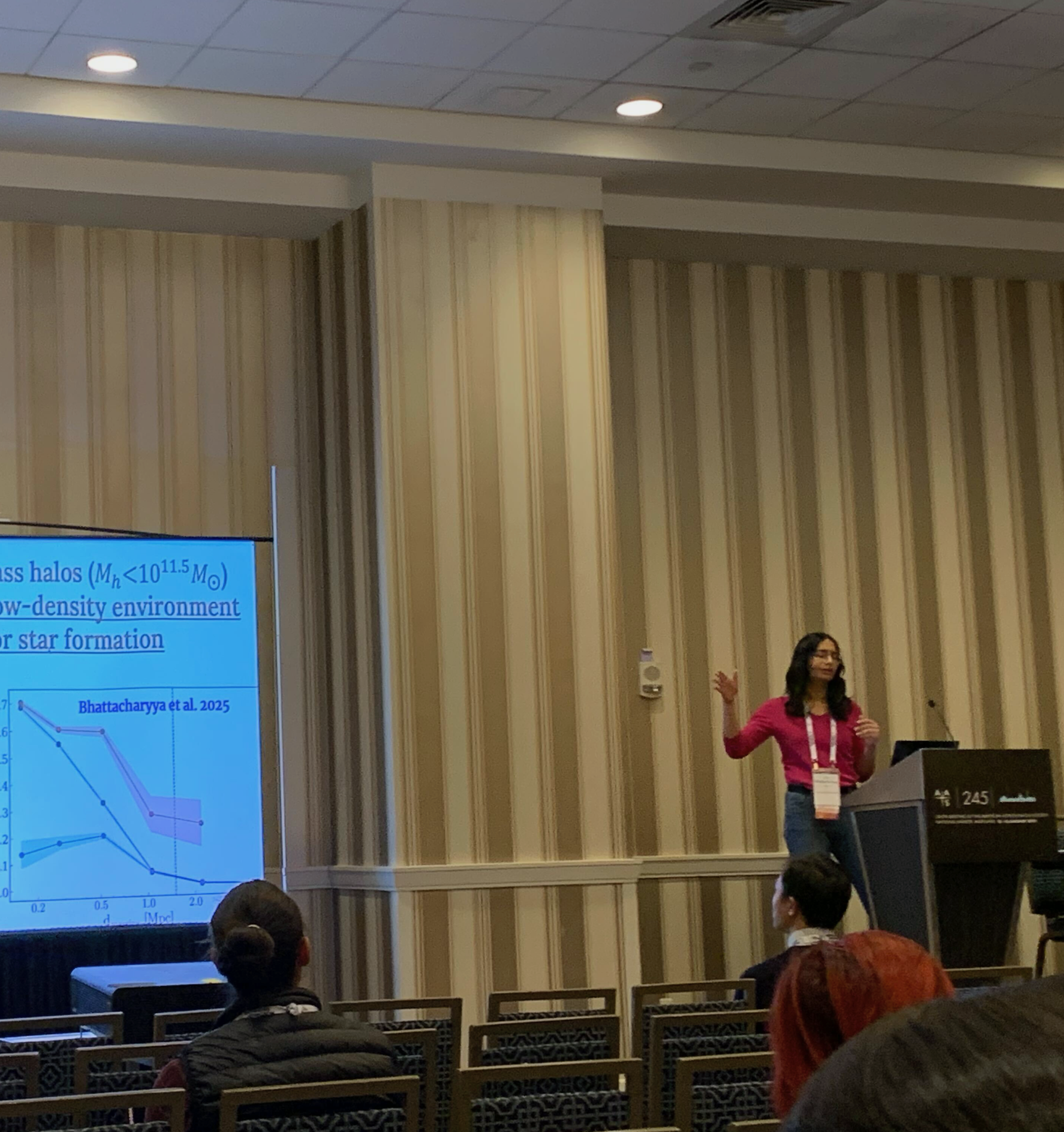
This paper studies dwarf galaxies in the TNG50 simulation to understand how their star-formation rates relate to their environments, finding that only about 1% of the most isolated field dwarfs are quenched while the vast majority of quenched field dwarfs are "backsplash" dwarfs near massive galaxy clusters.

Low-surface Brightness Galaxies in DES

This paper studies low-surface-brightness galaxies (LSBGs) near massive host galaxies ranging using Dark Energy Survey data, finding that LSBGs closer to their hosts are significantly redder and brighter and form a clear "red sequence" visible beyond the virial radius in both cluster and isolated environments.

Hot component of Circumgalactic Medium

This paper presents XMM-Newton observations around the sightline of Mrk 421, revealing that the Milky Way's circumgalactic medium requires a two-phase model consisting of a warm-hot virial phase and a hot super-virial phase, with the super-virial phase appearing widespread across five additional fields within 5 degrees of the primary sightline.

Self-interacting Dark Matter

This paper uses cosmological zoom-in simulations with velocity-dependent self-interacting dark matter (SIDM) to study subhalo properties within cluster-mass hosts, finding that subhalo abundance is suppressed in SIDM relative to cold dark matter (CDM), though satellite galaxy populations can be reconciled when accounting for disrupted subhalos that may host orphan galaxies.

Blazar Variability

This paper analyzes X-ray light curves of the blazars using AstroSat and XMM-Newton data, finding that their power spectral densities remain consistent across different epochs, validating the construction of broadband PSDs from multi-epoch observations, though the blazars exhibit hints of nonstationarity beyond their characteristic red-noise variability.